Alan Butz

August 2025 Market Intel

August 2025 Market Intel

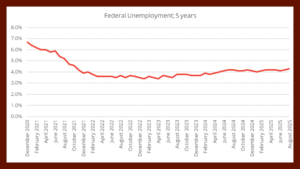
US National Unemployment Rate sees little change at 4.3%

The US national unemployment rate had a slight increase to 4.3%. Total nonfarm payroll employment changed little in August (+22,000) and has shown little change since April. Over the month, a job gain in health care was partially offset by losses in federal government and in mining, quarrying, and oil and gas extraction. The total number of unemployed persons changed little in August at 7.4 million. In August, the number of long-term unemployed (those jobless for 27+ weeks) saw little change at 1.9 million but has increased by 385,000 over the year. In August, long-term unemployment accounts for 25.7% of all unemployed people. The labor force participation rate for August saw little change at 62.3%, and the employment-population ratio remains at 59.6%.
Job Growth Sectors:

The following industry sectors saw notable job change in August:

  • Federal Government (-15K)
  • Health care (+31K)
  • Social Assistance (+16K)
  • Individual and Family Services (+16K)

In August, health care added 31K jobs, below the average monthly gain of 42K in the past 12 months. Employment continued to trend up over the month in ambulatory health care services (+13K), nursing and residential care facilities (+9K), and hospitals (+9K).

Wage Growth:

Average hourly earnings increased by 10 cents, or 0.3% in August, contributing to the 3.7% increase in average hourly earnings over the past 12 months.

Educational Attainment:

  • Unemployment for persons with less than a high school diploma rose notably to 6.7%. This sector remains the highest unemployment rate based on level of education.
  • High school graduates with no college decreased slightly in August to 4.3%.
  • Those with some college increased to 3.2%
  • Bachelor’s degree and higher remained the lowest group with no change at 2.7%.

July Metro Unemployment

Major Markets

  • Of the top 5 major US markets, DFW unemployment remained the lowest at 4%.
  • 5 out of 5 US markets had a MoM increase.
  • Of the top 5 major US markets, Houston saw the largest YoY decrease in unemployment of 50 bps.

Employment Changes in Key Metropolitan Areas

In July 2025, nonfarm payroll employment increased over the year in 34 metropolitan areas and was essentially unchanged in 353 areas.

The most significant employment gains occurred in:

  • New York-Newark-Jersey City, NY-NJ: Added 157,500 jobs.
  • Philadelphia-Camden-Wilmington, PA-NJ-DE-MD: Increased by 65,300 jobs.
  • Houston-Pasadena-The Woodlands, TX: Gained 62,600 jobs.

June 2025 Market Intel

June 2025 Market Intel

US National Unemployment Decreased Slightly to 4.1%

The US national unemployment rate decreased a little to 4.1%. Total nonfarm payroll employment increased by 147,000 in June, similar to the average monthly gain of 146,000 over the past 12 months. The total number of unemployed persons changed to 7.0 million. In June, 1.6 million people were considered long-term unemployed (those jobless for 27+ weeks); long-term accounts for 23.3% of all unemployed people. In June, the labor force participation rate decreased to 62.3%. and the employment-population ratio held at 59.7%.

Relevant Insights:

Job Growth Sectors:

The following industry sectors saw notable job change in June:

  • Government (+73K)
  • Federal Government (-7K)
  • Healthcare (+39K)
  • Social Assistance (+19K)

In June, job growth was led by government and healthcare sectors. Government growth was driven by state and local hiring, particularly in education. Healthcare growth can be attributed to job gains in hospitals and in nursing and residential care facilities.

Social assistance continues its upward trend, reflecting continued growth in individual and family services.

Wage Growth:

Average hourly earnings increased by 0.2% in June, maintaining a trend of wage growth over the past 12 months.

Educational Attainment:

  • Unemployment for persons with less than a high school diploma increased to 6.0%. This sector remains the highest unemployment rate based on level of education.
  • High school graduates with no college decreased slightly to 4.2% in June.
  • Those with some college increased slightly to 3.4%
  • Bachelor’s degree and higher remained the lowest group and decreased a little to 2.4%.

May Metro Unemployment

Major Markets

  • Of the top 5 major US markets, DFW unemployment remained the lowest at 3.7%.
  • 5 out of 5 US markets had a MoM decrease.
  • Of the top 5 major US markets, Houston saw the largest YoY decrease in unemployment of 30 bps.

Employment Changes in Key Metropolitan Areas

In May 2025, nonfarm payroll employment increased over the year in 23 metropolitan areas, decreased in 2 areas, and was essentially unchanged in 362 areas.

The most significant employment gains occurred in:

  • New York-Newark-Jersey City, NY-NJ-PA: Added 95,300 jobs.
  • Dallas-Fort Worth-Arlington, TX: Gained 46,800 jobs.
  • Miami-Fort Lauderdale-West Palm Beach, FL: Increased by 42,900 jobs.

Follow us on LinkedIn to stay up to date on latest insights.

May 2025 Market Intel

2025.05 Fidelis Market Intel


US National Unemployment Remained Steady at 4.2%

The US national unemployment rate remained steady at 4.2%. Total nonfarm payroll employment increased by 139,000 in May, similar to the average monthly gain of 149,000 over the past 12 months. The total number of unemployed persons remained at 7.2 million. In May, 1.5 million people were considered long-term unemployed (those jobless for 27+ weeks); long-term accounts for 20.4% of all unemployed people. In May, the labor force participation rate decreased to 62.4%. and the employment-population ratio decreased slightly to 59.7%.

Job Growth Sectors:

The following industry sectors saw notable job change in May:

  • Healthcare (+62K)
  • Leisure and Hospitality (+48K)
  • Social Assistance (+16K)
  • Government (-22K)

In May, healthcare led job growth reflects strong demand for medical professionals. Leisure and hospitality jobs increased as travel and entertainment remained steady, while social assistance grew in order to support essential services.

In contrast, government employment declined, likely due to budget shifts and seasonal changes. Overall, service industries continue to drive job growth, with healthcare and hospitality leading the way.

Wage Growth:

Average hourly earnings increased by 0.4% in May, maintaining a trend of wage growth over the past 12 months.

Educational Attainment:

  • Unemployment for persons with less than a high school diploma decreased to 5.5%. This sector remains the highest unemployment rate based on level of education.
  • High school graduates with no college increased slightly to 4.5% in May.
  • Those with some college decreases slightly to 3.3%
  • Bachelor’s degree and higher remained the lowest group and changed little to 2.6%.

Major Markets

  • Of the top 5 major US markets, DFW unemployment remained the lowest at 3.5%.
  • 4 out of 5 US markets had a MoM decrease.
  • Of the top 5 major US markets, Houston and Los Angeles saw the largest YoY decrease in unemployment of 20 bps.

Employment Changes in Key Metropolitan Areas

Over the year, nonfarm payroll employment increased in 20 metropolitan areas, decreased in 1 area, and was essentially unchanged in 366 areas

The most significant employment gains occurred in:

  • New York-Newark-Jersey City, NY-NJ-PA: Added 96,100 jobs.
  • Dallas-Fort Worth-Arlington, TX: Gained 52,100 jobs.
  • Philadelphia-Camden-Wilmington, PA-NJ-DE-MD: Increased by 35,800 jobs.


Tips for Finding the RIGHT Partner

5 keys to identifying the right partners 

Specialization

Nobody is an expert in everything. General IT staffing firms and MSP’s are great for your run of the mill IT roles, but when you are running complex systems specialization matters. Hire partners who are experts.  The firms you partner with should have deep relationships within their technology space and be active in those communities. This will deliver the expertise needed for a successful outcome.

Stability

Vetting out the stability of the partner you choose should be top of mind.  Look for financial stability. It is not always the size of the staffing partner that matters, it is their ability to pay their consultants in a timely manner, carry the insurances required to minimize risk, and the ability to scale their workforce to support your demands.

Longevity of Internal Staff

A large part of a successful relationship with a search/consulting partner is your sales rep and recruiting team’s ability to understand your organization and its unique IT needs and corporate culture. If the firm you are looking at seems to have a different rep. Calling on you every couple of months, you will run a high risk of mistakes being made and information getting lost in transition. Look for firms that work hard to retain and develop their internal staff. If there is no longevity or succession planning within their organization, they may be more risk than reward long-term. 


Back-Office Support

There is more to a partner than their ability to find talent. Engaging a firm with a strong back-office is critical in meeting the needs of today’s customer.  Look for firms who have the technology and financial capabilities to do what is needed to meet the demands that come with the size and scale of your organization and the services you will require.

Integrity 

A partner will always operate with honesty and integrity. Look for firms who operate under these principles. Talk to past customers about how they delivered on what they promised. How they handled challenging situations that arose and dealt with budget constraints to meet their commitments.

A  partner is going to be honest about what they can and can’t do. They will advise you on the resources they represent and the price points they can work within. Partners work through any challenges with integrity. A quality staffing firm should not be in the relationship for maximizing short-term profits and slinging resumes to fill positions. They should be in it for long-term partnerships and delivering a positive outcome for their customers.

Lessons learned are lessons shared


Over 20 years in professional services has taught us one thing- we can’t avoid mistakes, but we can learn from them. As a professional services firm, we work exclusively with one product -people- and people have a mind of their own. When we get an offer rejection, or someone chooses to terminate a contract early, we have to remind our customers and ourselves that no matter how hard we try, we ultimately can’t control the human condition of free will. We can, however, look for things to improve upon to make these outcomes happen less often.
The most common reasons we have found that people leave a contract early are as follows:
• The time commitment that was outlined in the beginning of the interview process does not line up with reality- either more or less hours than expected, or  more travel
• Extreme micro management over their role
• They are poached by another opportunity for more money
In response to the above, I have a few thoughts. Overall, what I have learned over a decade in this industry is that a simple and honest approach is always the best approach.
• Regarding expectations of hours and travel:
We believe in an open and honest approach in the hiring process. We take a reality based approach when it comes to travel and workload and I don’t add any fluff or positive spin. We take pride in speaking plainly and openly. We have found that this tactic causes a lot less hurt feelings and missed expectations.
• Regarding micromanagement:
We understand the desire to micromanage, and agree for the initial 30 days of a contract its proper to keep a tighter oversight schedule, however, at Fidelis, we counterbalance the tendency for companies to micromanage new employees by placing highly qualified, energetic consultants that continually beat expectations. We continue to collaborate with our clients throughout the hiring and process and beyond.
• Avoid your consultants being poached:
What we have learned over the years of being in the people business  is a simple and honest approach is always the best approach. We create significant value for our clients by being upfront with them about the candidates we propose, the process ahead of us, and the associated costs.
We are all going to make mistakes, but as long as we approach life with a growth mindset, we can improve and minimize issues along the way.
Over the next coming months we will be doing a series of posts related to our industry. Topics to include:
• How to proactively determine “red flags” in the hiring process
• The negative effects of “ghosting”, which also leads to the topic…
• Why my recruiter didn’t respond. Is it me?
We welcome more topic ideas and look forward to your response. Our goal is to create an open space to productively work through ideas to improve your experience both from both a customer and consultant perspective.